Misogi Before the Wedded Rocks: Taking Part in Futami's Geshi-sai With Our Students
On June 21, 2026 — the summer solstice, the longest day of the year — we took part in the Geshi-sai at Futami Okitama Shrine in Futami, Ise City. It is an Ise ritual of greeting the sun as it rises between the Meoto-iwa (the "Wedded Rocks") standing in the sea, and of misogi — purifying body and mind in the water before them. Students of Tokiwakai joined us to meet the solstice dawn on the shore.
The Solstice Sun, Rising Between the Wedded Rocks
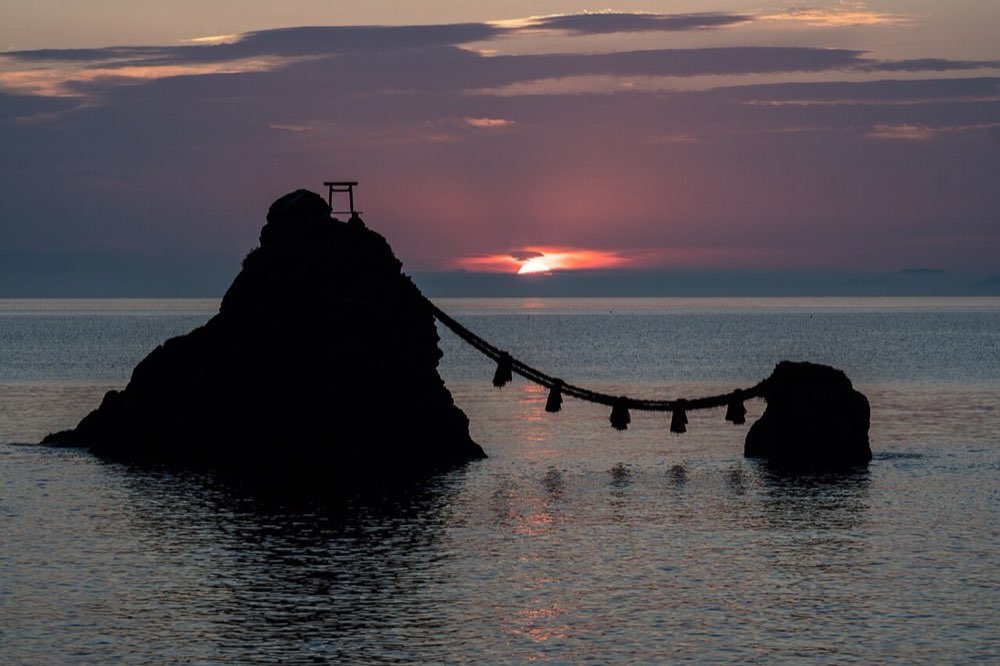
Futami Okitama Shrine enshrines Okitama-no-Okami — also known as Sarutahiko-no-Okami — and has long been known as a place of purification (misogi). Offshore, a sacred rock called the Okitama Shinseki is said to rest beneath the waves. The Meoto-iwa, the Wedded Rocks — two rocks, one large and one small, joined by a great shimenawa (sacred straw rope) — serve as a torii gateway through which worshippers face that hidden rock and the rising sun.
Around the summer solstice, the sun rises exactly between these two rocks. On clear mornings, the distant silhouette of Mt. Fuji is said to appear beyond them. To greet light born from the sea on the longest day of the year — this is Ise's way of welcoming the solstice, where calendar, nature, and prayer are drawn into a single line.
From Morning Mist to Blue Sky
This year's Geshi-sai came after a night of steady rain. Yet just as the misogi ritual began in the sea before the Wedded Rocks, the rain lifted, and a quiet morning mist settled over the grounds. Then, during the singing of the national anthem, the mist drew back and a patch of blue sky opened through the leaden clouds — a dramatic turn of weather befitting the solstice dawn.
The sea was calm, without waves. As the white-robed participants waded in together up to their shoulders, the water rippled outward with their movement. To wash away the impurities of body and mind and greet the solstice light — it sounds simple in words, but there is a texture to that prayer you feel only when you lower yourself into the cold sea.
Reflections
Students from Tokiwakai took part in the misogi as well. Takagi Shunsuke, a member joining for the second year running, shared these words with reporters on the day:
"The water level and temperature were different from last year, but stepping into the sea left me refreshed in body and mind. Last year the sky was perfectly clear; this year it turned to mist — and that, too, was deeply otherworldly. Seeing both kinds of beauty, a gratitude toward nature welled up in me. This misogi gave me strength for the next half year, and I want to pour it into my research as I head toward graduate school."
Clear last year, misty this year — stand at the same solstice sea two years in a row, and you begin to see how it shifts. To join one's hands to ever-changing nature, and take part in a prayer handed down unchanged: that a younger generation could stand within that rhythm was, more than anything, the harvest of the day.
Walking Ise's Year, Season by Season
If the monthly Tsuitachi-mairi marks the turning of each month, the Geshi-sai let us stand at a turning point of the whole year. In Ise, a way of life that joins one's hands to nature at each change of season still lives on today. We are glad to have stood in that place together with a younger generation.
Tokiwakai is dedicated to passing on Japan's traditional culture and nurturing the next generation, from our base in Ise. Not knowledge read from books, but the feel of the hours themselves — standing on the shore at daybreak, waiting for the light. We will continue to build such moments of experience together with our students. We hope you will join us for the seasonal observances to come.
* Details of the day and the participant's comment draw on this article by Ise-Shima Keizai Shimbun (in Japanese).
The next news arrives on LINE.
Notices, reports, and the next event openings.